

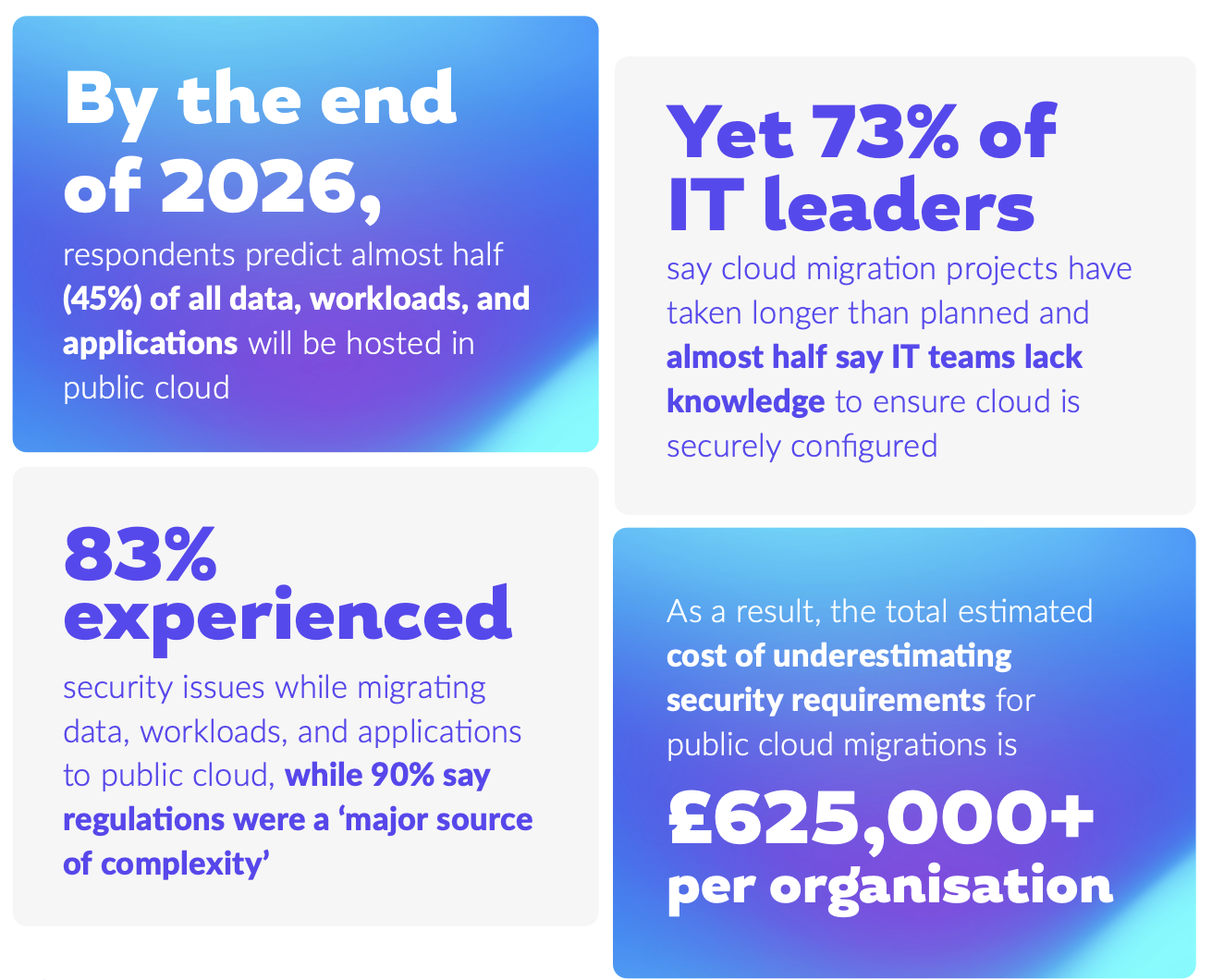
Cloud migration is no longer a side project. It is now a core part of how UK organisations modernise infrastructure, improve agility and prepare for what comes next. Our new report Secure by Design: The New Blueprint for Cloud Migration shows that by the end of 2026, respondents expect almost half of all data, workloads and applications to be hosted in public cloud. At the same time, 79% of organisations either use or plan to use AWS, underlining just how central AWS has become to cloud transformation strategies in the UK.
That shift matters. But so does the way organisations approach it.
The same research shows that while cloud adoption is accelerating, many migration programmes are still being slowed down by security issues, compliance complexity and unclear ownership.
-
73% of respondents say cloud migration projects have taken longer than planned.
-
83% have experienced security issues during or after migration.
-
90% say regulations are a major source of complexity.
-
And the average cost of underestimating security requirements is now more than £625,000 per organisation.
The challenge is no longer whether to move to the cloud. It is whether you can do it with enough security, structure and control to make the move sustainable.
Want the full findings? Download the Secure by Design report for the latest data on cloud migration, AWS adoption and security risk across UK organisations.
What is secure cloud migration?
Secure cloud migration is the process of moving data, workloads and applications into the cloud with security, compliance and governance built in from the start.
That sounds obvious. In practice, many organisations still treat security as something to validate after architecture decisions have been made or workloads have already gone live. The report shows that 57% of respondents say security teams are consulted too late in migration planning to have a meaningful impact, while 52% have been part of a migration where security requirements were overlooked, underestimated or addressed late.
That is exactly where friction begins.
When security arrives late, organisations end up redesigning controls, remediating misconfigurations and absorbing avoidable delays. 85% say post-migration audits often reveal preventable security mistakes, and one in ten organisations report having suffered a breach linked to late-stage security implementation.
Secure cloud migration means breaking that pattern. It means designing identity, visibility, compliance and governance into the platform before the migration gathers pace.
Why cloud migration is now a business priority
Cloud migration has crossed the line from transformation initiative to operating model.
According to the report, respondents estimate that public cloud will host 31% of their data, workloads and applications in 2025, 45% by the end of 2026, and 62% by 2030. That is not just steady growth. It is a structural shift in how organisations run core services.
The upside is clear. Organisations that have migrated report benefits such as performance improvements, improved data management and increased scalability. Cloud has also become a foundation for AI, automation and modern application delivery, which means it now sits much closer to growth and competitive advantage than it did even a few years ago.
But the more cloud becomes business-critical, the less tolerance there is for migration programmes that create risk, slow delivery or leave governance behind.
Why secure cloud migration projects still get delayed
If cloud migration is now mainstream, why are so many organisations still struggling to execute it cleanly?
Because the most common blockers are not usually about cloud capability. They are about operating discipline.
The report shows that all respondents who experienced migration delays cited security and or compliance as significant contributing factors. A third reported delays of more than three months. That tells you something important: the issues slowing migration are not edge cases. They are systemic.
The most common challenges include:
- Data exposure during transfer
- Cost predictability and management issues
- Integration issues
- Identity challenges
- Limited visibility during and after migration
These are exactly the kinds of problems that get worse when architecture, security and governance are not aligned early.
Why security-by-design matters more than post-migration fixes
Security-by-design is not just a security principle. It is a delivery principle.
The report makes this point clearly. 91% of respondents agree that strong security is best achieved by incorporating it by design rather than relying on post-migration assessments or tools. That is not just a theoretical preference. It reflects the cost and operational drag organisations are already feeling when they leave security too late.
Late-stage security implementation leads to:
- increased operational workload
- greater exposure to vulnerabilities after migration
- increased project costs due to rework
- compliance and audit issues surfacing late
- delays caused by redesign and remediation
This is where many migration programmes lose momentum. Teams focus on speed, then end up spending more time fixing what should have been designed correctly in the first place.
That trade-off is visible in the data. 81% of respondents believe migration success is too often measured on delivery speed rather than security or compliance outcomes, and 67% say budget constraints have forced them to prioritise speed over security.
Fast matters. But fast without control is not transformation. It is deferred risk.
What a secure cloud migration strategy should include
A secure cloud migration strategy should do four things from the outset.
1. Build security in early
Security needs to be involved before migration patterns, identity models and control boundaries are locked in. That means treating security and governance as part of platform design, not a post-go-live assurance step.
2. Make compliance continuous
Compliance should not be something you test once systems are live. 80% say compliance requirements often delay or derail migration projects, and 83% say compliance violations are often only discovered after workloads go live. A stronger approach is to build automated validation and assurance into the migration process itself.
3. Clarify ownership and control
One of the most revealing findings in the report is that 77% of respondents believe their public cloud provider is responsible for securing all aspects of the environment. That misunderstanding creates gaps fast. Cloud providers secure the underlying infrastructure. Customers still own their data, identities, configurations and operating controls.
4. Standardise visibility and governance
64% say inconsistent security configuration and tooling has created blind spots, and 82% say alert fatigue has increased since migrating to public cloud. A secure migration strategy needs standardised controls, consistent telemetry and less fragmented tooling.
Where AWS fits into secure cloud migration
AWS is not just one option in the mix. For many organisations, it is the anchor platform.
79% of organisations use or plan to use AWS, and 77% have used or plan to use AWS Migration Acceleration Program, or MAP, to support migration. That matters because secure migration depends not just on infrastructure, but on the frameworks, guardrails and funding models that help teams build correctly from day one.
AWS brings the native foundation. But the report is also clear that tooling alone is not enough. Most organisations rely on partners and third-party platforms to bridge gaps in visibility, security and execution. Only 12% manage cloud migration security entirely in-house.
That is exactly where the right partner model changes the outcome.
Why the AWS Partner model matters
The strongest migration programmes combine cloud platform capability, security capability and delivery capability.
The report puts it plainly: successful migrations typically combine three elements — scalable cloud platforms, unified security platforms and specialist partners that orchestrate secure design, execution and governance.
This is not about dependency. It is about acceleration with control.
A strong AWS partner helps organisations:
- Design security and governance in early
- Translate compliance requirements into technical controls
- Reduce misconfiguration and blind spots
- Make better use of AWS funding such as MAP (Migration Acceleration Programme)
- Build a cloud operating model that can scale after migration
That is the difference between simply moving workloads and building a cloud platform that delivers long-term value.
FAQs
What is secure cloud migration?
Secure cloud migration is moving data, workloads and applications into cloud environments with security, compliance and governance designed in from the start rather than added after go-live.
Why do cloud migration projects fail or slow down?
They usually slow down because security and compliance are handled too late, ownership is unclear, and teams lack consistent visibility across environments.
How do you reduce security risk during migration?
Bring security into planning early, define ownership clearly, automate compliance validation, and standardise controls across identities, workloads and cloud services.
Why is AWS important for secure migration?
AWS is central to many UK organisations’ cloud strategy, and programmes like AWS MAP can help reduce cost and risk when used as part of a structured, secure-by-design migration approach.
Final takeaway
Cloud migration is no longer the risky outlier. It is now the platform decision shaping resilience, agility and long-term competitiveness.
But the organisations getting the most from cloud are not the ones moving fastest at any cost. They are the ones building with control from the start. Security-by-design, continuous compliance, clearer ownership and stronger visibility are no longer optional extras. They are what make migration work.
If you are planning your next phase of AWS migration, Cloud Bridge can help you assess your current posture, identify the gaps that create drag, and build a migration strategy designed for security, speed and scale.
Get in touch today now for your complimentary migration assessment.


